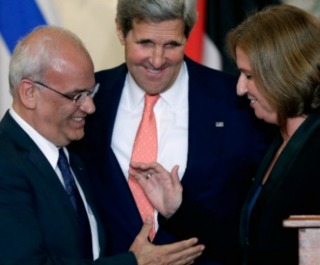
This resource page will offer you background, analysis and commentary on the talks - anything you need to follow the new diplomatic initiative.
 Newest Information/Analysis
APN Publications
Peace Now (Israel) Publications
Other Recommended
Reading
Official Statements (U.S. & the
Parties)
Background on the
Negotiators
Additional Resources
APN Publications
Press Release: APN Welcomes Formation of Palestinian
Government; Calls to Judge it by its Positions and Actions: June 2, 2014.Such unity is vital for empowering the
Palestinian leadership to credibly conduct negotiations with Israel and to reliably implement a future peace
agreement.
The Palestinians & the UN: Resource
Page
Israeli-Palestinian
Mutual Recognition: Resource Page
Hard Questions, Tough Answers with Yossi Alpher: May 5, 2014. Alpher
discusses why the Netanyahu government threatens to refuse to negotiate with a Fateh-Hamas Palestinian Authority
unity government, and more.
APN Briefing Call - Shibley Telhami briefing call on
the state of the Israeli-Palestinian peace effort April 28, 2014
APN Press Release: Potential Benefits of Pause in
Israeli-Palestinian Talks April 25, 2014
Press Release: APN Welcomes PLO-Hamas Reconciliation
Agreement April 23, 2014
Yossi Alpher, on the flurry of obstructive
peace process-related events of the past week, what derailed the process, and what could save it; the broader
international situation; more basic or strategic factors informing the crisis; how serious the immediate damage is
and how all this affects Israeli politics April 7, 2014
Hard Questions, Tough Answers with Yossi Alpher:
Alpher discusses how critical Monday's meeting between Palestinian leader Mahmoud Abbas and US President Barack
Obama is likely to be; why it took Obama and Kerry all this time to recognize just how far apart the two sides are
- and more. March 17, 2014
Press Release: Settlement Surge Looms Large over Netanyahu-Obama
Meeting March 3, 2014.
Hard Questions, Tough Answers with Yossi Alpher: Alpher discusses the
possible dynamics of PM Netanyahu arriving to talk with President Obama in the midst of the Ukraine/Crimea crisis;
the influence of the Ukraine crisis on the Middle East; what we can expect in the weeks ahead regarding the
American-sponsored framework agreement and Monday's Obama-Netanyahu meeting; and Netanyahu's thinking for the "day
after" failure scenario. March 3, 2014
APN's Lara
Friedman in The New York TimesThe New York Times - APN's Lara Friedman and Rabbi Daniel Gordis debate: Is a
Settlement Boycott Best for Israel? March 2, 2014.
Yossi Alpher, what motivates pro-settler critics of Kerry; what the
Israeli public thinks about the danger of sanctions; whether there is more than meets the eye to the issue of the
controversy provoked by Netanyahu's remark that he "doesn't intend to remove a single settler;" and more.
February 10, 2014
APN Briefing call with Jerusalem expert Daniel Seidemann.
February 7, 2014
Kerry's consequences, is Abbas making concessions? and more: Hard
Questions, Tough Answers with Yossi Alpher February 3, 2014.
Yossi Alpher, how the Israeli and Palestinian leaderships are positioning themselves in anticipation of being
presented with some sort of framework agreement by US Secretary of State John Kerry. January 13, 2014
Yossi Alpher, on Kerry's prononcements on the peace process and FM Lieberman's recent comments that seem to view
Kerry's performance as highly productive. January 6, 2014
Yossi Alpher, on what's different about Kerry, Israeli opposition to a deal brokered by Kerry, and the interaction
between Israeli prisoner release and the new settlement construction. December 30, 2013
Briefing Call with
Israeli political analyst Akiva Eldar December 9, 2013
APN
Welcomes Apparent Walk-back of New Settlement Planning Tenders, Awaits Next Steps November 13, 2013
Peace
Now report: Dramatic Surge in Settlement Construction. October 17, 2013
Daniel
Seidemann, APN's Lara Friedman at The Daily Beast: Netanyahu Must Rein in Extremists in Coalition, or Risk
Derailing Peace Talks.August 28, 2013
APN's Lara Friedman at The Jewish
Journal: Why the Israeli-Palestinian peace talks must work.August 15, 2013
Podcast: APN's Lara
Friedman on Mideast Peace Propects at Voice of America, August 14, 2013
APN's
Lara Friedman, Blog post: Netanyahu's Prisoners vs. Settlements Game August 14, 2013
APN's Lara
Friedman, Blog post: A review of Israel's commitments regarding Palestinian prisoner release August 14,
2013
APN's Lara Friedman, Blog
post: New Peace Talks, New Settlement Provocations -- A Timeline, August 12, 2013
APN Statement
Condemning New Settlement Tenders, Calling for Strong U.S. Response August 12, 2013
Yossi Alpher, on upcoming
round of peace talks August 13, 2012
APN's
Lara Friedman at The Huffington Post: Peace Talks, Settlements and Smirking Into the Abyss. August 11,
2013
APN Statement
Condemning Israeli Government's Subsidizing Settlements August 6, 2013
Yossi Alpher on
settlement announcements, the referendum question, & the EU settlement directive August 5, 2013
APN
Welcomes Indyk Appointment; Welcomes Negotiators to DC. July 29, 2013
Podcast: APN's on Ori Nir Public Radio International's "To the Point" on the newly restarted Israeli-Palestinian
peace negotiations July 31, 2013
Yossi Alpher on
prisoner release, Washington talks, and the EU July 29, 2013
Podcast: APN's Lara Friedman assesses the US role in peace talks
at a BICOM/Fathom Forum in London July 23, 2013
Yossi
Alpher on the renewal of peace talks & the EU settlements July 22, 2013
APN
Briefing Call with Ian Black, the Middle East Editor of the Guardian. July 22, 2013
APN Welcomes
Resumption of Peace Talks; Urges Leaders to Negotiate in Earnest; Calls for Stakeholders' Support. July 19,
2013
APN Statement: This Is The News That
We've Been Waiting For. July 19, 2013
APN: Settlement Construction Takes
Center Stage. July 17, 2013
APN Welcomes New EU Policy on Settlements; Condemns Anticipated New Settlement Approvals. July 16, 2013
APN Peace Parsha: Is the Land Holy? July 5, 2013
"About them, the words of Jeremiah ring as true today as they did when they were spoken-'You entered and defiled
My land.'"
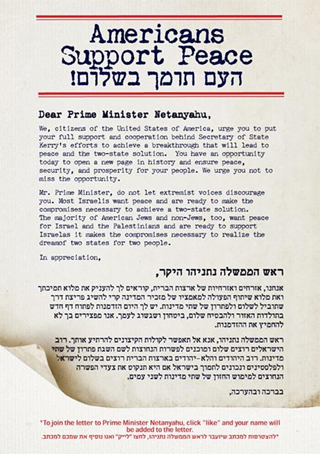
APN Campaign: Our Leaders Must Know:
We Want Peace! July 2, 2013
Peace Now (Israel) Publications
Peace Now News Flash: Minister of Defense approves new settlement in
Hebron, first time since the 1980s. April 14, 2014
New Peace Now report:
Over 800 additional housing units promoted as part of the 2nd prisoner release. November 26, 2013
[UPDATED] New Peace Now/APN Report: Bibi's
Settlements Boom -- Even Bigger Than Was Known November 12, 2013
New Peace Now/APN Report: Bibi's Settlements
Boom -- March-November 2013 November 8, 2013
Drastic Rise in Construction in the Settlements. October 17,
2013
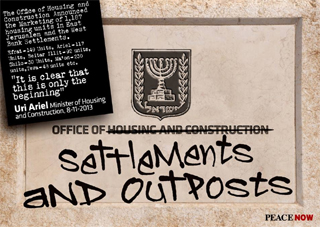
Peace Now News Flash: Government
announces 1,187 housing units in East Jerusalem and West Bank settlements for marketing. August 11, 2013
 Peace Now News Flash: Over
1000 Units Promoted in Settlements; Promise to Restrain Settlement Growth During Negotiations. August 8,
2013
Peace Now News Flash: Over
1000 Units Promoted in Settlements; Promise to Restrain Settlement Growth During Negotiations. August 8,
2013
Peace Now News Flash:
Israeli Government Declares 91 settlements As National Priority Areas: 89 of them East of the Built Separation
Barrier. August 4, 2013
 Al-Monitor Interview with Peace Now's Yariv Oppenheimer:EU Boycott Contributes To
Israeli Decision on Peace Talks, July 24, 2013
Al-Monitor Interview with Peace Now's Yariv Oppenheimer:EU Boycott Contributes To
Israeli Decision on Peace Talks, July 24, 2013
Haaretz - Peace Now's Yariv Oppenheimer:
Bennett and Katz Playing Into The Hands of Hamas. July 28, 2013
Peace Now's Yariv Oppenheimer in YNet:
Europe: A Step on the Road to South Africa
Peace Now News Flash:
3 Months Into The New Government, 5,170 Plans Advanced. July 22, 2013
Peace Now News Flash:
Israel's State Comptroller: 'Israeli Authorities' Act Against the Law and For the Settlers.' July 17,
2013
Peace Now's Activities
& Media Update: July 2013
Haaretz - Barak Ravid: EU levels veiled threat of new sanctions over latest settlement expansion: June 5, 2014.Calls on Israel to cancel tenders for 1,500 homes and refreeze plans for another 1,800 in the West Bank and East Jerusalem.
Haaretz Chaim Levinson, Barak Ravid and Jack Khoury:Israel advancing plans for 1,800 new settlement units - on top of tenders for 1,500 units: June 5, 2014.Palestinians warn their reaction will be 'unprecedented;' U.S. envoy Dan Shapiro criticizes move, says White House opposed to settlement construction.
Haaretz- Barak Ravid: Kerry to Israel: U.S. intends to work with new Palestinian government: June 2, 2014. State Department spokeswoman says U.S. to continue disbursing aid to the PA but will monitor its policies.
Walla, via Israel News Today- Shaul Arieli: The Illusion of the Unilateral Solution: May 27, 2014.The prime minister is aware of the fact that the political deadlock does not serve Israel’s interests and is liable to produce new American and European initiatives, as well as more emphatic efforts by the Palestinians to secure UN recognition. By airing that slogan, Netanyahu hopes to keep everyone busy in the next few weeks guessing about its content, and less busy working on new initiatives of their own.
Bloomberg View - Jeffrey Goldberg: Netanyahu Says Obama Got Syria Right : May 22, 2014. But Netanyahu, though seemingly relaxed, was also quite difficult. We spent the first 10 minutes of our discussion renegotiating the terms of our meeting (when I could use a digital recorder, topics we could cover on the record, and so on). I quickly remembered a truism about Netanyahu: that he would give live television interviews on background if such a thing were possible.
Al-Monitor - Akiva Eldar: Israel pushes West Bank toward economic disaster: May 21, 2014.They wrote that even though the vast majority among the Palestinian public and leadership is interested in continued security calm that will ensure progress in building the state and the economy, the deadlock could bring about popular unrest directed at Israel and the PA. "Under these circumstances," the two wrote, "the positions of Hamas and other opposition groups might be strengthened, undermining the stability achieved through Israeli military presence in the area and security coordination."
Haaretz - Akiva Eldar: The Quartet is waiting for Bibi: May 19, 2014. And see, Prime Minister Benjamin Netanyahu is the one who made the rule “If they give, they will receive, and if they do not give, they will not receive.” Let us take a look, then, at the extent to which Netanyahu has fulfilled those conditions.
Maan - Gaza, West Bank govts to resign when unity govt announced: May 19, 2014.
Haaretz - Barak Ravid: Obama’s plan: Let Netanyahu and Abbas stew in their juices: May 18, 2014. Senior White House official tells Haaretz U.S. president hopes that after a few months with no negotiations and less U.S. involvement, both sides will understand it is in their interest to renew talks.
The Washington Post - David Ignatius: Why the Mideast peace process is in tatters: May 16, 2014.If these catastrophic developments ensue, Israel will find itself living with a one-state solution after all. Optimists think this might provide reality therapy, showing that Israel can survive as a healthy Jewish state only if a Palestinian state exists, too.
Haaretz - B. Michael: Israel's strict adherence to (Groucho) Marxism: May 16, 2014.Israel's policy toward the Palestinians could be summed up by tweak of Groucho's famous credo: 'Anyone who claims to be ready to talk with us proves, by saying so, that he is not worthy to be a negotiating partner.'
The Jordan Times - George S. Hishmeh: ‘The options are not good’: May 16, 2014. However, Aaron David Miller, a former senior negotiator in the Middle East peace process, told Bernard Gwertzman in an interview at the Council on Foreign Relations, that Netanyahu’s government, which includes extremist right-wing members, “frankly, isn’t inclined to support the kind of conflict-ending agreement that the Palestinians and Americans would like”.
Statesman.com - Aron Heller: White House official urges Mideast talks continue: May 7, 2014. Rice told Israeli Prime Minister Benjamin Netanyahu that while negotiations have hit a pause, the U.S. "remains convinced that lasting peace can only be secured through direct negotiations that lead to two viable, independent states living side by side in peace and security," according to a statement released by the White House.
The American Prospect - Matt Duss: The Bitter Truth about the Settlements: May 6, 2014. How can talks succeed when, throughout the negotiations, Israel is building on the very land that would comprise a Palestinian state?
YNet (AFP): US denies dismantling peace negotiators team: May 6, 2014. Some senior US officials to return to Israel 'soon,' deputy State Dept. spokeswoman says; confirms Kerry is mulling whether to release document laying out principles reached in peace talks.
New York Times - Isabel Kershner: After Failed Peace Talks, Pushing to Label Israel as Occupier of Palestine May 4, 2014. "Among the first treaties the Palestinians joined were the four Geneva Conventions of 1949 and additional protocols of 1977 on the laws of war. Others deal primarily with human rights issues such as discrimination against women and the rights of children."
Haaretz - Barak Ravid: U.S. envoy Indyk likely to resign amid talks blowup May 4, 2014. "Special envoy for peace talks said to blame Israel for negotiations failure."
Times of Israel - AFP & Times of Israel staff: Palestinians officially join 5 UN treaties May 2, 2014. "PA becomes signatory to conventions banning racial discrimination, protecting human rights."
YNet - Nahum Barnea: Inside the talks' failure: US officials open up May 2, 2014. "There are a lot of reasons for the peace effort's failure, but people in Israel shouldn't ignore the bitter truth - the primary sabotage came from the settlements."
Reuters: Kerry says he'll pause, reassess after Israeli-Palestinian peace bid. May 1, 2014 "'Both parties still indicate that they feel it's important to negotiate and want to find a way to negotiate,' secretary of state says."
New York Times - Ali Jarbawi: Why Abbas Reconciled With Hamas May 1, 2014. "This may explain why Mr. Abbas has endorsed Palestinian applications to join international treaties, as well as his recent recurrent statements that he wants to step down. He appears to have embarked upon two divergent paths simultaneously, despite the fact that they are contradictory. He has done so in the hope, perhaps, that one of them will stick."
Al Monitor - Ben Caspit:Israel worried Indyk will walk April 29, 2014. "'It’s such a pity that John Kerry fostered some of the traits of [Prime Minister] Benjamin Netanyahu,' a senior member of Israel’s shrinking peace camp said on the night of April 28, in a personal, closed talk."
Bloomberg View - Jeffrey Goldberg:Is Israel an Apartheid State? April 29, 2014. "The problem is not inside Israel; the problem is on the West Bank. The settlers who entangle Israel in the lives of Palestinians believe that they are the vanguard of Zionism. In fact, they are the vanguard of binationalism. Their myopia will lead to the end of Israel as a democracy and as a haven for the Jewish people."
The National - Faisal Al Yafai:When even America uses the word apartheid, will Israel listen? April 28, 2014. "Politicos in Tel Aviv and Israel’s supporters in Washington were incensed. The use of the A-word is toxic within Israeli and American political circles, although it is increasingly accepted elsewhere. What was less discussed, however, was why Mr Kerry might be using the word."
Haaretz - Jack Khoury and DPA: PLO votes to sign Palestine up for 63 UN accords - Abbas to decide when April 28, 2014. "The PLO's moves follow Israel's suspension of the peace talks last week after Abbas' Fatah party signed a unity agreement with Hamas, culminating a month of tit-for-tat diplomatic blows that began when Israel refused to carry out its last scheduled release of Palestinian prisoners."
Haaretz - Barak Ravid: U.S. envoy Indyk leaves Israel as talks falter, no clear plans for return April 28, 2014. "U.S. and Israel seemingly on collision course over what happens if technocrats' cabinet is established in Ramallah."
The Daily Beast - Josh Rogen: Exclusive: Kerry Warns Israel Could Become ‘An Apartheid State’ April 27, 2014. "Secretary Kerry, like Justice Minister Livni, and previous Israeli Prime Ministers Olmert and Barak, was reiterating why there's no such thing as a one-state solution if you believe, as he does, in the principle of a Jewish State. He was talking about the kind of future Israel wants and the kind of future both Israelis and Palestinians would want to envision," she said. "The only way to have two nations and two peoples living side by side in peace and security is through a two-state solution. And without a two-state solution, the level of prosperity and security the Israeli and Palestinian people deserve isn't possible."
Brookings Institute - Tamara Cofman Wittes: What Matters, and What Doesn’t, About Palestinian Unity April 25, 2014. "But the agreement is a fact and, rather than either dismissing it or declaring it a disaster, the United States government should make clear the conditions under which Fatah-Hamas reconciliation could work to advance the two-state solution to the Israeli-Palestinian conflict that is at the heart of U.S. policy. Here are some guidelines..."
New York Times - Judi Rudoren: Israel Halts Talks, Citing Palestinian Unity Agreement April 24, 2014."'The government of national consent that will be established, headed by Abu Mazen, will declare clearly and unequivocally that it accepts the Quartet’s conditions,' Mr. Rajoub said, using Mr. Abbas’s nickname in an interview on Israel's Army Radio channel. 'There is no cause for concern.'"
Haaretz - Barak Ravid: Israel suspends talks with Palestinian Authority over Fatah-Hamas unity deal April 24, 2014. "At the end of five hours of discussion, the mini-cabinet voted unanimously to halt the peace talks, whose allotted time runs out on Tuesday, until the make-up of the new Palestinian government and its policy become clear."
Haaretz: PA official says Hamas accepted two-state solution April 24, 2014."Wednesday's reconciliation agreement between Fatah and Hamas recognizes the existence of Israel and is based on the two-state model, says Jibril Rajoub."
Reuters: U.S. official says Hamas-PLO government would prompt aid reassessment April 24, 2014."'Any Palestinian government must unambiguously and explicitly commit to non-violence, recognition of the state of Israel, and acceptance of previous agreements and obligations between the parties,' the U.S. official said, listing terms Hamas has long rejected."
Haaretz - Barak Ravid: Foreign Ministry: Palestinian reconciliation not near implementation April 24, 2014. "The ministry document said that Palestinian President Mahmoud Abbas is hopeful the reconciliation with Hamas will "provide leverage over Israel to renew the negotiations on his own terms" and will challenge the Hamas policy vis-à-vis the peace process. On the other hand, Hamas hopes the agreement will change Egypt's negative stance toward the group, ensure its integration into PLO institutions, and give its West Bank members more leeway."
Haaretz - Barak Ravid and Jack Khoury: U.S.: New Palestinian government must recognize Israel, renounce violence April 23, 2014. "A senior administration official told Haaretz that the United States will recognize the unity government expected to be formed under the agreement only if it recognizes Israel, renounces violence and adheres to previous agreements signed by the Palestine Liberation Organization."
Bloomberg Businessweek - Calev Ben_David and Saud Abu Ramadan: Palestinian Groups Agree on Unity Government, Officials Say April 23, 2014. "If Hamas does join a Palestinian unity government, 'they would probably allow Abbas to continue talking to Israel while insisting as they have in the past that any agreements require approval from the Palestinian public in a referendum vote,' said Mark Heller, research fellow at the Institute for National Security Studies at Tel Aviv University."
The New York Times - Isabel Kershner: Abbas Renews Threat to Dissolve Palestinian Authority if Peace Talks Fail April 22, 2014. “If the negotiations fail finally, then we will say to the Israeli government, ‘Here is the authority, you have emptied it of all content, take it,’ Mr. Abbas said. In that case, he continued, Israel would become responsible for security and for the health, education and economic well-being of the Palestinians who live in the West Bank."
The New York Times - Thomas Friedman: Not the Same Old, Same Old April 15, 2014. "The truth is Kerry’s mission is less an act of strategy and more an act of deep friendship. It is America trying to save Israel from trends that will inevitably undermine it as a Jewish and democratic state. But Kerry is the last of an old guard. Those in the Obama administration who think he is on a suicide mission reflect the new U.S. attitude toward the region. And those in Israel who denounce him as a nuisance reflect the new Israel."
Haaretz Editorial: Israel's new land grab is clearly illegal April 15, 2014. "The Defense Minister’s green light to appropriate land in the West Bank places him in the extreme right and shatters Israelis’ hopes for resolving the conflict with the Palestinians."
Foreign Policy - Michael Singh: What Washington is Missing in the Israeli-Palestinian Peace Talks April 15, 2014. "The question, therefore, is not whether to have a peace process, but what approach can stabilize the peace talks and increase long-term chances for producing an agreement. There are four elements that the Obama administration should incorporate going forward."
Reuters - Ari Rabinovitch: Israeli coalition partner threatens to quit over peace talks April 11, 2014. "A key partner in Prime Minister Benjamin Netanyahu's coalition threatened on Friday to pull out of the government if a deal to salvage peace talks with the Palestinians includes the release of Israeli-Arab prisoners."
Times of Israel - Spencer Ho and Elhanan Miller: Netanyahu suspends state contact with PA April 9, 2014. "Punitive step against Ramallah excludes Defense Ministry, security collaboration and peace negotiations"
The New York Times - Mark Landler: Mideast Frustration, the Sequel April 8, 2014. "Explaining to the senators why his latest efforts to bring together the Israelis and the Palestinians had almost broken down last week, Mr. Kerry could have been channeling Secretary of State James A. Baker III when he explained a similar impasse to House members 24 years ago."
The New York Times - Mark Landler: Israeli Settlement Plan Derailed Peace Talks, Kerry Says April 8, 2014. "While Mr. Kerry said both sides bore responsibility for “unhelpful” actions, he noted that the publication of tenders for housing units came four days after a deadline passed for Israel to release Palestinian prisoners and complicated Israel’s own deliberations over whether to extend the talks."
Politico - Zbigniew Brzezinski, Frank Carlucci, Lee Hamlton, Carla A. Hills, Tomas Pickering and Henry Siegman: Stand Firm, John Kerry April 8, 2014. "We believe these efforts, and the priority Kerry has assigned to them, have been fully justified. However, we also believe that the necessary confidentiality that Secretary Kerry imposed on the resumed negotiations should not preclude a far more forceful and public expression of certain fundamental U.S. positions..."
Haaretz- Barak Ravid: "U.S. envoy meets Palestinians, Israelis again after late-night talks end in deadlock" April 7, 2014."Israeli official says Sunday meeting was positive and serious but disagreements remained unchanged."
New York Times- Jodi Rudoren: "Israelis and Palestinians Ask U.S. Envoy for New Meeting" April 7, 2014."“The entire Jewish Home and Uri Ariel, first and foremost, have only been waiting for an opportunity to continue to build, to make more statements, to bring the world down on our heads and prevent us from reaching an arrangement,” Ms. Livni said in an Israeli television interview broadcast Saturday night, referring to Mr. Ariel’s right-wing faction."
Reuters- Lesley Wroughton and Maayan Lubell: " Israel may freeze settlement construction for peace talks" April 1, 2014."Israel may impose a partial settlement freeze to keep U.S.-brokered peace talks with the Palestinians alive, an Israeli source close to the negotiations said on Tuesday."
Haaretz - Ofer Aderet: "Camp David minutes show how understanding overcame distrust" March 26, 2014. “Not only is everything up for negotiation, I was asked if East Jerusalem was subject to negotiation,” Dayan said. “I said yes – we annexed it unilaterally, and it is subject to negotiation even though we annexed [it]. It’s true that we’ve applied Israeli law [there], but this fact doesn’t mean that the issue can’t be negotiated. You know this is a very sensitive issue for our people."
The Times of Israel - Avi Issacharoff: "Hamas would accept peace with Israel, West Bank leader says" March 25, 2014. “If Israel will accept the rights of our nation and allow the establishment of the Palestinian state with full sovereignty like any other people, in my estimation it is possible there will be peace."
The Austin American-Statesman - Jon Gerberg : "Israelis, Palestinians endorse Arab peace plan" March 24, 2014."It's one thing to have a peace agreement between Israel and Palestine," said Bar, a member of the opposition Labor Party. "It's another thing to have Israel and Palestine as a joint partner in a much bigger neighborhood."
The Jerusalem Post - Yehuda Sharoni: "Manufacturers: Leave 'Made in Israel' label off products from beyond Green Line " March 21, 2014. "The manufacturers complain that factories over the Green Line benefit from tax breaks and other advantages, but do not always operate in accordance with the rules of Israeli industry, such as meeting certain quality standards and upholding workers' rights."
The Spectator - Daniella Peled : "Is Hamas finally losing its grip on Gaza?" March 21, 2014. "Could Hamas succumb to its perilous circumstances and fall? Before we get too excited about that, consider that many in Gaza, even those who detest the current regime, shudder at the thought of what would happen if one of the other armed groups took over. ‘If Islamic Jihad controlled Gaza, Hamas rule would seem like a paradise,’ says one resident."
The Washington Institute - Matthew Levitt: "West Bank Violence and Gaza Rockets Could Spark Wider Conflict " March 20, 2014. "President Mahmoud Abbas's White House meeting with President Obama this week was intended to spark support for the peace process among Palestinians and a sense of urgency among all parties. There is no guarantee that a deal will be reached within the current timeline. Yet as frustrating as the current lack of progress is, a return to armed struggle -- by Fatah, Hamas, or others -- would be a disaster for Palestinians."
The Inquirer - Trudy Rubin: Worldview: If not two states, what? March 20, 2014. "The secretary of state probably wishes he never launched his quixotic campaign for Mideast peace a year ago. Palestinian President Mahmoud Abbas' Monday meeting with President Obama at the White House only illustrated the unbridgeable gulf between Israeli and Palestinian positions."
Bloomberg - Jeffrey Goldberg: Obama to Israel -- Time Is Running Out March 2, 2014. "In an hourlong interview Thursday in the Oval Office, Obama, borrowing from the Jewish sage Rabbi Hillel, told me that his message to Netanyahu will be this: "If not now, when? And if not you, Mr. Prime Minister, then who?" He then took a sharper tone, saying that if Netanyahu "does not believe that a peace deal with the Palestinians is the right thing to do for Israel, then he needs to articulate an alternative approach." He added, "It's hard to come up with one that's plausible."
Haaretz - JTA: "Poll: 30 percent of settlers outside blocs would evacuate without peace deal" March 18, 2014. "The survey also found that nearly 50 percent of the 100,000 settlers living in areas likely to become part of a Palestinian state under a peace agreement would voluntarily evacuate after an agreement, while 40 percent would not."
Foreign Policy - Shibley Telhami: America Has a Plan. And, No, It Isn't One That Israel Would Like. March 2, 2014. "A public opinion survey I commissioned, which was conducted by the polling firm GfK, found that U.S. popular support for a two-state solution is surprisingly tepid. What's more, if the option is taken off the table, Americans support the creation of a single democratic state -- in what is now Israel and the Palestinian territories -- in which Jews and Arabs are granted equal rights. The GfK survey consisted of 1,000 interviews conducted through an Internet panel and was weighted to ensure that the results were consistent with several demographic variables, such as age, education, and income."
Foreign Policy - Aaron David Miller: Bibi Trapped: Why Israel's prime minister can't call the shots on Iran or the peace process. February 27, 2014. "There is a sense that, even though the peace process seems to have gone on forever, this is a last chance. (It's a trope Kerry has repeatedly hyped.) And there's a fear among both the Israelis and the Palestinians that they will be blamed for the collapse, what former U.S. Secretary of State James Baker used to call having a dead cat left on the doorstep. Bibi, certainly, cannot leave the Kerry process without good reason. If he were to do so or if the process were to collapse and Israel were to be blamed, the Palestinians' Plan B would be to go to the United Nations and resume their campaign for recognition in the international arena (which the United States would oppose). Israel, meanwhile, has no plan B. Settlement activity wouldn't stop -- and further moves by foreign states to pressure Israel would be inevitable. "
The Forward - Nathan Jeffay: Business Coalition Pushes Israel's Benjamin Netanyahu To Forge Peace Deal" February 28, 2014. "“There are several examples in which the business community took a role in resolving the conflict,” said BTI member Yadin Kaufmann, a venture capitalist. “South Africa is one, Northern Ireland is another — and I’m not drawing a parallel between one place and another.” In September 1985, 91 leading businesspeople in South Africa published newspaper ads calling for the end of apartheid."
The New York Times - Thomas L. Friedman: "Israel’s Big Question" February 11, 2014. "... I believe that if Secretary of State John Kerry brings his peace mission to a head and presents the parties with a clear framework for an agreement, Israel and the Jewish people will face one of the most critical choices in their history. And when they do, all hell could break loose in Israel. It is important to understand why."
The New
York Times - Thomas L. Friedman: "The Third Intifada" February 4, 2014. "This Third Intifada, in my view, has
much more potential to have a long-term impact because, unlike the first two, it is coinciding with the offer from
the Palestinian president, Mahmoud Abbas, as part of a two-state deal, to let Israeli troops stay for five years as
they make a phased withdrawal from the West Bank to the 1967 lines and to then let U.S.-led NATO forces fill in any
strategic void to reassure Israel.
To put it differently, the Third Intifada is based on a strategy of making Israelis feel strategically secure but
morally insecure."
The New York Times - Thomas L. Friedman: "Abbas’s NATO Proposal" February 2, 2014. "Yes, it will require Israel, the Palestinian Authority and America to all agree to do something they’ve long felt was outside their strategic comfort zones. But this is nothing. For them to strike a comprehensive peace deal on all the other core issues, they will have to leave many, many more comfort zones behind."
The New York Times - Jodi Rudoren: "Palestinian Leader Seeks NATO Force in Future State"" February 2, 2014. "Six months into peace talks dominated by discussion about security, President Mahmoud Abbas of the Palestinian Authority has proposed to Secretary of State John Kerry that an American-led NATO force patrol a future Palestinian state indefinitely, with troops positioned throughout the territory, at all crossings, and within Jerusalem."
The Jerusalem Post - Gil Hoffman: "Lapid threatens coalition over peace process " January 18, 2014. "Yesh Atid will leave Prime Minister Binyamin Netanyahu’s governing coalition if the diplomatic process with the Palestinians does not advance, Yesh Atid leader Yair Lapid warned Saturday in an interview with Channel 10."
JPost - Greer Fay Cashman: "Biden urges Israelis, Palestinians to seize opportunity in peace talks " January 13, 2014. "'You come not only on a sad day, but at a time when Israel has to take tough and serious decisions,' said Peres, adding that Prime Minister Binyamin Netanyahu is making a serious attempt to take the right decision and make peace."
AFP - Jo Biddle: "Kerry ends Mideast trip without framework deal." January 6, 2014. "However, Netanyahu told Likud party members on Monday he would make no "territorial concession" in the Jordan Valley, West Bank or annexed east Jerusalem, Channel 10 television reported."
Haaretz - Jonathan Lis: "Israeli ministers to vote on new bill to curtail West Bank settlement construction". January 5, 2014. "The Ministerial Committee for Legislation will vote Sunday on a private bill submitted by MK Merav Michaeli (Labor) that would block any new construction in areas beyond the Green Line unless it received the backing of 80 Knesset members."
Haaretz - Peter Beinart: "In 2014, American Jewish leaders might lose control of the Israel debate". January 1, 2014. "The Israeli-Palestinian conflict isn't a pivotal issue in American politics. But Iran is, and the generational divide is just as strong. The Iraq War was a far more disillusioning experience for young Americans than for their elders, and you can see Iraq's legacy in the polling on Iran, where according to a 2012 Pew poll, Americans under 30 were thirty points more likely than Americans over 65 to prioritize "avoid[ing] military conflict" with Tehran over "tak[ing] a firm stand" against its nuclear program. When I asked the indispensable folks at Pew to break down the age gaps within the parties, they found that young Republicans were almost as anti-war as old Democrats."
Haaretz - AP: "Kerry to offer outline of Mideast peace deal" December 31, 2013. "State Department deputy spokeswoman Marie Harf said Kerry will discuss with Israeli Prime Minister Benjamin Netanyahu and Palestinian President Mahmoud Abbas a proposed framework to serve as a guideline for addressing all core issues in the decades-long dispute. The core issues include the borders between Israel and a future Palestine, security arrangements, the fate of Palestinian refugees and conflicting claims to the holy city of Jerusalem."
Times of Israel - Elhanan Miller: "US deal will trade off 'Jewish' Israel for 1967 lines -- report" December 29, 2013. "US Secretary of State John Kerry will offer Israeli and Palestinian negotiators a political trade-off: Israeli recognition of the 1967 lines as a basis for the future Palestinian state, in return for Palestinian recognition of Israel as the state of the Jewish people, Palestinian sources told the Saudi daily Al-Watan on Sunday."
The Forward - Yossi Alpher: "A Mideast Peace 'Bridge' Too Far?" December 23, 2013. "Judging by the West Bank security plan presented recently to the two sides by Kerry and John Allen, a retired Marine Corps general, Washington might come forward with bridging proposals as it becomes clear that the framework agreement essentially defines the gaps between the two sides' positions on each key issue. According to some reports, it will do so in late January, regardless of the status of the framework agreement."
L.A. Times - Maher Abukhater: "Palestinian negotiator: peace 'framework' with Israel possible " December 18, 2013. "'April 29 is time for a framework agreement,' Erekat told foreign reporters in this West Bank town near Bethlehem. 'We are not talking about a final peace treaty but only a framework agreement, which is halfway to a final treaty.' He said the final peace treaty will come six to 12 months after signing the framework agreement, which will be implemented in stages."
Yossi Alpher: "How Middle East regional dynamics affect the Israeli-Palestinian peace process" December 12, 2013. "On the other hand, the seeming convergence of views regarding Iran and Syria among Israel, Saudi Arabia, other Gulf Arab states, Jordan (see below) and possibly Egypt - with all the Arab states recognising that Israel currently presents the only likely military deterrent to Iran - could provide an incentive for Israel to register progress in peace negotiations. The Saudis, after all, appear to condition overt security co-operation with Israel against Iran on a successful peace process or at least progress toward this end, citing the Arab Peace Initiative as a possible framework."
Jeffrey Goldberg:"John Kerry Is Israel's Best Friend" December 11, 2013. "Kerry was at his most emotional -- and yes, pro-Israel -- when he described the benefits of peace and when he warned of what would happen to Israel if it continued to settle land that needs to become part of the new state of Palestine for that state to be viable. "Just think of how much more secure Israel would be if it were integrated into a regional security architecture and surrounded by newfound partners," Kerry said. "Think of an end to the unjust but also inexorable campaign to delegitimize Israel in the international community."
Shibley Telhami: "Would Israelis and Palestinians Support a Realistic Peace Deal?" December 9, 2013. "Existing polling has shown that there are many final status issues on which there are serious gaps between the views of the Israeli public and the Palestinian public. But most poll questions are simply asking people their preferences. Negotiating a deal requires finding a package of proposals that includes elements that are not necessarily preferred but can be tolerated by each side. If these publics were to advise their negotiators, what would they say?"
Yuval Diskin: Speech to Geneva Initiative 10 Year Conference - Leading the Way to Peace December 4, 2013. "I would very much like for our home to have clear and agreed borders, to have neighborly relations with our neighbors, and that our homeland reflects values and a consensus that echoes the right priorities: that we put the sanctity of people before the sanctity of land, and I also want a home that does not require the occupation of another people in order to maintain itself."
Arutz Sheva: "Olmert: We've Declared War on Obama Gov't" December 1, 2013. "There is one state in the world that votes for Israel in the UN throughout the years, systematically, even in cases when we were not necessarily 100% right. They always stood at our side. All of these attacks, all the attempts to sic Congress against the American administration - this is a very serious mistake. The only way is to cooperate with the US, modestly, with restraint, with wisdom, and not carry out the argument in unceasing attacks on the American administration."
Maan: " Poll: Oslo brought 'political normalization' but no benefits." November 19, 2013 "Furthermore, 83.3 percent of the respondents believe that settlement construction increased "unprecedentedly" in the Palestinian territory as a result of the Oslo Accord. "
Haaretz: "Hollande: Jerusalem should be capital of Israel and Palestine." November 18, 2013 "France opposes the settlements," Hollande told a joint press conference after the meeting with Abbas. "Construction in the settlements must be stopped because it will make it more difficult to achieve a two-state solution and get the two sides back to the negotiating table."
Haaretz: "David Makovsky joins Indyk's Middle East peace team." November 18, 2013 "Makovsky has written extensively on the Middle East and particularly on the subject of the Israeli-Palestinian conflict and the peace process. 'Myths, Illusions, & Peace: Finding a New Direction for America in the Middle East,' which he co-wrote with Denis Ross, was published in 2009."
AP - Haaretz: "Kerry extends Mideast trip in effort to salvage peace talks.". November 7, 2013 "'Both Prime Minister Netanyahu and (Palestinian) President Abbas reaffirmed their commitment to these negotiations despite the fact that at moments there are obviously tensions,' Kerry said."
Mark Landler and Jodi Rudoren - New York Times: Kerry's Path Steepens in Israeli-Palestinian Talks. November 6, 2013 "Mr. Kerry, who came to Jerusalem to recapture the initiative in the moribund talks, struggled to keep them from slipping into a familiar cycle of recrimination on Wednesday. Under pressure from President Mahmoud Abbas of the Palestinian Authority, he declared that the Palestinians had not accepted continued building in settlements as an Israeli condition for restarting talks, despite what Israeli leaders had indicated."
Barak Ravid - Haaretz: Netanyahu: Israel will examine any peace proposal but will accept no dictates. November 4, 2013 "Senior MK tells Haaretz Obama administration plans to present draft framework for permanent status agreement with Palestinians in January."
Barak Ravid - Haaretz: U.S. to propose Israeli-Palestinian peace deal in January, senior MK tells Haaretz. November 4, 2013 "Meretz chairwoman says U.S. Secretary of State John Kerry told Prime Minister Benjamin Netanyahu of plan during Rome meet."
Haaretz: "Israeli ministers approve release of 26 Palestinian prisoners for peace talks." October 27, 2013 "...The committee's decision was made after the government rejected a bill put forth by right-wing party Habayit Hayehudi, which sought to ban the release of imprisoned terrorists as part of peace negotiations."
Aviad Kleinberg - YNet: This is not how you make peace. October 10, 2013 "...The thing is that political disputes do not remain roots. They grow stems and branches and produce rotten fruit. It is convenient for Netanyahu to go back to 1921 and 1947, just as it is convenient for him to go back, again and again, to Haj Amin al-Husseini and his cooperation with the Nazis. A long time has passed since al-Husseni was the leader of the Palestinian nation; the Nazis have passed from the world, and the year is 2013, not 1921."
YNet: "Jerusalem pushes forth with settlement plans" Monday, August 25, 2013.
Ha'aretz: "In peace deal, East Jerusalem would be Palestinian capital" taken from comments made by Yesh Atid MK Ofer Selah at a Peace Now event. Monday, August 19, 2013.
Why is Israel 'opening up the settlement floodgates' just as peace talks start? August 12, 2013 - interview
with Danny Seidemann in the Washington Post "...There are a few different theories for why the Israeli government
does this. The most prevalent is that Prime Minister Benjamin Netanyahu is likely trying to appease more hard-line
members of his government, who might be unhappy with Netanyahu's decision to release 104 Palestinian prisoners, a
concession to the peace process. Other theories are that Israeli officials are seeking to improve their negotiating
position by approving settler construction that they can later roll back, that they're trying to deliberately
undermine the peace process or that they want to humiliate Palestinian leaders and weaken them within Palestinian
politics."
Dov Weisglass- YNet: This is not how you make
peace. August 8, 2013 "...The Israeli government's decision is aimed at deepening, expanding and enlarging the
Israeli "holes" in the Palestinian 'slice of cheese,' despite knowing full well that the Palestinians will never
agree to a state that is dissected by Israeli settlements, and neither will the international community. "
Open Zion- Matt
Duss: Giving Talks The Best Chance Possible. August 8, 2013 "...While the images of a U.S. secretary of state
shuttling back and forth from the Middle East may seem familiar on the surface, Secretary Kerry's efforts to create
movement on a range of fronts marks a shift in strategy for the administration. While still acknowledging direct
talks between Israelis and Palestinians as the necessary arena for final status negotiations, Secretary Kerry's
approach is based on the understanding that certain steps can and must be taken in order to give the talks a
greater chance of success. "
The Boston Globe- Alan Berger: The Mideast
gamble. August 2, 2013 "What has been derided as a quixotic quest is actually a shrewd bet."
The Boston Globe- Farah
Stockman: 'Getting to Yes' in the Middle East. July 30, 2013 "They said it couldn't be done. But he did it.
Monday night, John Kerry got Palestinian and Israeli negotiators to agree to eat a meal together for the first time
in years. They say talks can't make peace. But who knows without trying? One thing we know for sure is that peace
doesn't make itself. "
The Forward - Yossi Alpher:
The Issues the Peace Process Should Avoid. July 29, 2013 "...Let's suspend our skepticism and assume real
negotiations begin and that the two sides are capable of delivering on the concessions they offer. Assuming all
that, the most important challenge the Israelis and Palestinians face is to agree to abandon the disastrous mantra
that has defined their deliberations for 20 years: "nothing is agreed until everything is agreed."
Text of the EU statement on
"Guidelines on the eligibility of Israeli entities and their activities in the territories occupied by Israel since
June 1967 for grants, prizes and financial instruments funded by the EU from 2014 onwards." July 19, 2013
Jerusalem
Post- Yuval Diskin: Israel nears point of no return on 2-state solution. July 15, 2013
The Atlantic- Special Report: Is Peace
Possible?
Chapter 1: Drawing an
Israel-Palestine Border. October 25, 2011
Chapter 2:
The Role of Security in an Israeli-Palestinian Peace Deal. October 31, 2011
Chapter 3: Resolving
the Palestinian Refugee Crisis. November 7, 2011
Chapter 4:The
Future of Jerusalem. November 14, 2011
Official Statements (U.S. & the Parties)
Remarks as Prepared by White House Coordinator for the Middle East, North Africa, and the Gulf Region
Philip Gordon at the Ha'aretz Israel Conference for Peace July 8, 2014. "Cynics
would say this conference is badly timed. Peace talks have been suspended, and the tragic kidnappings, killings,
and demonstrations over the past several weeks mean that peace between Israelis and Palestinians is the wrong
agenda.
I would argue just the opposite. Indeed, I applaud Ha’aretz for responding to the suspension of negotiations not by
moving on to other issues but by assembling this distinguished group of experts and political leaders to ask how we
can all do better. Because the lesson of the past several weeks is not that we would be better off focusing on
other challenges but that the inability to resolve the conflict between Israelis and Palestinians inevitably means
more tension, more resentment, more injustice, more insecurity, more tragedy, and more grief."
Ambassador Martin Indyk: Remarks on the Israeli-Palestinian
Negotiations, The Washington Institute's Weinberg Conference: Ambassador Martin Indyk: "The settlement movement
on the other hand may well drive Israel into an irreversible binational reality. If you care about Israel’s future,
as I know so many of you do and as I do, you should understand that rampant settlement activity – especially in the
midst of negotiations – doesn’t just undermine Palestinian trust in the purpose of the negotiations; it can
undermine Israel’s Jewish future."
Secretary of State John Kerry: Interview With
Jake Tapper of CNN's The Lead February 5, 2014. January 24, 2014. Secretary Kerry: "...no one should distort
what we’re doing or saying because they’re opposed to the peace process or don’t like two states or whatever. And
words – I have to tell you, my friend – I’ve been, quote, attacked before by people using real bullets, not words,
and I am not going to be intimidated."
Secretary of State John Kerry: Remarks at the
World Economic Forum January 24, 2014. Secretary Kerry: "Well, the reason that we are so devoted to trying to
find a solution is really very simple: Because the benefits of success and the dangers of failure are enormous for
the United States, for the world, for the region, and most importantly, for the Israeli and Palestinian people.
After all the years expended on this, the last thing we need is a failure that will make certain additional
conflict."
Secretary Kerry's Press Availability in Tel
Aviv December 13, 2013. Secretary Kerry: "Our goal remains as it always has been - for the Israelis and
Palestinians to reach a final status agreement - not an interim agreement, a final status agreement. And both
parties remain committed to fulfilling their obligations to stay at the table and negotiate hard during the
nine-month period that we set for that."
Secretary Kerry's Remarks at the
Transformational Trends Strategic Forum December 11, 2013. Secretary Kerry: ""President Obama is committed to
this process because he understands that the possibilities of peace are dramatic and worth fighting for: a secure,
Jewish, and democratic Israel living alongside a sovereign and independent Palestinian state; an Israel that enjoys
peace and normalized relations with 22 Arab nations. That's what waiting if you can implement a peace, because
that's what's been promised in the Arab Peace Initiative, which has now been updated to include the possibility of
swaps along '67 lines, as long as Israel is recognized - and also with 35 Muslim nations - 57 nations in all in one
fell swoop."
10th Anniversary Saban Forum Power Shifts: U.S.-Israel Relations in a Dynamic Middle Eastwith audio for the
Conversation with U.S. President Barack Obama, Keynote address by U.S. Secretary of State John Kerry, Address by
Israeli PM Benjamin Netanyahu, and Conversation with Israeli FM Avigdor Lieberman.
Full transcript of President Obama's talk is here.
Full transcript of Secretary of State Kerry's remarks are here.
Full transcript of Israeli PM Netanyahu's remarks are here.
December 6-8, 2013.
Secretary Kerry's Press Availability at Ben
Gurion International Airport December 6, 2013 Secretary Kerry: "He said, "It always seems impossible until
it is done." I think it's appropriate for us to think about that in the context of the work that I've been doing
here in the last couple of days and over these last months, and of the hopes and aspirations of the people of this
region. That example of Nelson Mandela is an example that we all need to take to heart as we face the challenge of
trying to reach a two-state solution."
Secretary Kerry's Joint Statement With Israeli
Prime Minister Benjamin Netanyahu December 5, 2013 Secretary Kerry: "General John Allen, who is one of the
very best military minds in the United States, one of our most experienced military leaders, who has been spending
months now analyzing the security challenges with respect to this process - President Obama has designated him to
play a very special role in assessing the potential threats to Israel, to the region, and ensuring that the
security arrangements that we might contemplate in the context of this process will provide for greater security
for Israel."
Secretary Kerry's Statement Following Meeting
With President Mahmoud Abbas December 5, 2013 Secretary Kerry: "We, I think, made some progress in
discussing some of the ideas that are on the table. We are not going to discuss these further publicly, but I will
say that the goal here for everybody is a viable Palestinian state with the Palestinian people living side by side
in peace with the state of Israel and with the people of Israel."
Secretary Kerry's Remarks With Israeli Prime
Minister Benjamin Netanyahu Before Their Meeting October 23, 2013. PM Netanyahu: "The second thing we're
discussing all the time - and I'm not revealing state secrets if I tell you that we - the Secretary and I talk more
or less every other day about these twin goals - is to advance the peace with the Palestinians. That peace is
premised on mutual recognition of two states for two peoples - the Palestinian state for the Palestinian people
mirrored by the Jewish state for the Jewish people."
Secretary Kerry's Remarks With Qatari Foreign
Minister Khalid al-Atiyah Before Their Meeting October 21, 2013 Secretary Kerry: " I might comment that in
the middle of our meeting today, His Highness Prince Saud al-Faisal of Saudi Arabia very eloquently stated, 'You
know, if you're thinking about what the vision for peace of the Arab world, all you really have to do is look at
the Arab Peace Initiative, which offers immediate peace to Israel when settling the Palestinian issue, a peace that
will bring normal commerce, embassies, normal relations, connections between people and between countries, not with
one or two nations, but with 57 nations all at one time - 35 Muslim nations, 22 Arab nations. That's a vision, and
it's a vision worth fighting for.'"
Knesset winter
session opens with remarks from President Peres and PM Netanyahu. October 14, 2013 PM Netanyahu: "I will
tell you something that goes against the accepted view - easing the pressure will not strengthen moderate trends in
Iran. On the contrary, it will strengthen the uncompromising views of the real ruler of Iran, the Ayatollah
Khamenei, and will be seen as a significant victory by him."
Transcript of Special Envoy Martin
Indyk's Remarks at the J-Street Gala. September 30, 2013.
Indyk: "Now is the time to go back to your communities and engage the skeptics and those who have been
disheartened by so many of the failures of the past. To tell them that peace is possible, that it is not a mirage,
that this does not need to end badly. Tell them the peacemakers need their help. Israel needs their help. That if
you just sit on the sidelines and lament the world that is, rather than work for the world that can be, we will
never achieve peace."
John Kerry Remarks at the Meeting of the Ad Hoc
Liaison Committee. September 25, 2013 Secretary Kerry: " think it's an understatement to say that the
breadth and depth of the leadership in this room is a very clear demonstration of the commitment of the
international community to the cause of peace between Israel and the Palestinians. And I think it's a testimony to
the fact that everybody here knows in your gut and in your head that the two-state solution is the only way
forward. I've read occasionally in the papers lately some people who try to assert a one-state solution, on one
side or the other, I might add. Anybody who has studied this issue through the years knows there is no one-state
solution. There is no peace through the concept. There is no capacity for people of either Palestinian or Israeli
nationality to find peace through that solution. We have to move to the two-state solution, and we have to do it
rapidly.."
Remarks With Israeli Prime Minister Benjamin
Netanyahu After His Meeting With Secretary Kerry. September 15, 2013 PM Secretary Kerry: "I am talking to
both leaders directly. And everybody, I think, understands the goal that we are working for. It is two states
living side by side in peace and in security. Two states because there are two proud peoples, both of whom deserve
to fulfill their legitimate national aspirations in a homeland of their own, and two states because today, as we
commemorate the 40th anniversary of the Yom Kippur War, I think everybody is reminded significantly of the costs of
conflict and the price, certainly, that Israelis have paid in the quest for their security and
identity."
Painful Exchange between State Department Spox and a
Journalist regarding U.S. policy on settlements and Jerusalem. August 14, 2013
Remarks With Brazilian Foreign Minister Antonio
de Aguiar Patriota After Their Meeting (Scroll down about 3/4 of the page for Remarks on the peace process).
August 13, 2013 Secretary Kerry: "Let me make it clear: The policy of the United States of America with respect
to all settlements is that they are illegitimate, and we oppose settlements taking place at any time, not just the
time of the peace process."
Middle East Peace
Negotiators Come To Washington. August 1, 2013, published on the White House blog.
Obama: "The most difficult work of these negotiations is ahead, and I am hopeful that both the Israelis and
Palestinians will approach these talks in good faith and with sustained focus and determination. The United States
stands ready to support them throughout these negotiations, with the goal of achieving two states, living side by
side in peace and security." Kerry: "I think everyone involved here believes that we cannot pass along to
another generation the responsibility of ending a conflict that is in our power to resolve in our time... while I
understand the skepticism, I don't share it and I don't think we have time for it... A viable two-state solution is
the only way this conflict can end, and there is not much time to achieve it, and there is no other
alternative."
Remarks on the Middle East Peace Process Talks
(with video). July 30, 2013 Secretary Kerry: "We're here today because the Israeli people and the
Palestinian people both have leaders willing to heed the call of history, leaders who will stand strong in the face
of criticism and are right now for what they know is in their people's best interests. Their commitment to make
tough choices, frankly, should give all of us hope that these negotiations actually have a chance to accomplish
something."
Transcript of Background Briefing on
Israeli-Palestinian Peace Talks. July 30, 2013 Official: "...we are under no illusions that this is going
to be easy. It's going to be very, very hard, and it's going to take some very, very tough choices by the leaders
if we're going to get where we were all trying to get to."
Special Briefing by a Senior White House Official and
Senior State Department Official on Israeli-Palestinian Peace Talks. July 30, 2013
Official: "As the Secretary announced, we watched final status negotiations, direct final status negotiations
between the parties today. [Senior White House Official] mentioned, I think, the atmosphere was excellent between
the parties. We tackled mainly process issues. This summer, you can imagine, is the beginning of a nine month
negotiation. There are certain modalities that need to be worked out between the parties. We agreed on the next
meeting, which will take place in the region within the next two weeks. We discussed the U.S. role, and as the
Secretary said, we will be playing the role as facilitator. We will be deeply engaged in the process and we will be
there every step of the way."
Statement by President Obama on the Resumption of Israeli-Palestinian Negotiations. July 29, 2013 Obama: "I
am pleased that Prime Minister Netanyahu and President Abbas have accepted Secretary Kerry's invitation to formally
resume direct final status negotiations and have sent senior negotiating teams to Washington for the first round of
meetings. This is a promising step forward, though hard work and hard choices remain ahead."
Transcript Of SecState Kerry's Remarks With
Ambassador Martin Indyk. July 29, 2013
Kerry: "Ambassador Indyk is realistic. He understands that Israeli-Palestinian peace will not come easily and
it will not happen overnight. But he also understands that there is now a path forward and we must follow that path
with urgency. He understands that to ensure that lives are not needlessly lost, we have to ensure that
opportunities are not needlessly lost. And he shares my belief that if the leaders on both sides continue to show
strong leadership and a willingness to make those tough choices and a willingness to reasonably compromise, then
peace is possible."
Transcript of SecState Kerry's Statement on Resumption of Israeli-Palestinian Peace Talks. July 19, 2013
Kerry: "On behalf of President Obama, I am pleased to announce that we have reached an agreement that
establishes a basis for resuming direct final status negotiations between the Palestinians and the Israelis. This
is a significant and welcome step forward."
Remarks at the American Jewish Committee Global
Forum by SecState Kerry. June 3, 2013
Kerry: "I thank you, every single one of you, for all that you do for Israel, but more for human rights, for
civil rights around the world, for women's rights, in fighting racism, religious intolerance, and torture. Thank
you for all that you do to fight anti-Semitism around the world. I'm proud that I just appointed Ira Forman to lead
that fight against anti-Semitism from the State Department, and you have a very strong partner in Ira. And of
course, I thank you for what you do for the American Jewish community."
Remarks to Special Program on Breaking the
Impasse World Economic Forum. May 26, 2013 Secretary Kerry: "Now, one thing I want to make crystal clear,
and President Peres mentioned this in his comments: The Palestinian-Israeli conflict is not the cause of the Arab
Awakening. But this fundamental principle of what economics can do to play a profound role in meeting the needs of
both peoples is critical."
 Tzipi
Livni
Tzipi
Livni
Livni is the current Israeli Minister of Justice. She has held 9 Cabinet portfolios in various governments,
including serving from 2006-2009 as the Minister of Foreign Affairs when she was the head of the Kadima party. She
now heads the Hatnuah party.
 Yitzhak
Molcho
Yitzhak
Molcho
Molcho is a lawyer and longtime advisor to Benjamin Netanyahu, Molcho headed the Israeli negotiating team under the
previous Netanyahu government.
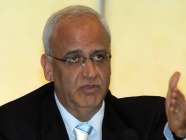 Saeb
Erekat
Saeb
Erekat
Erekat is a veteran leader of Palestinian negotiations with Israel, dating back to the 1991 Madrid peace
conference, though the present day.
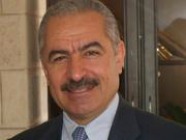 Mohammad Shtayyeh
Shtayyeh is another veteran Palestinian peace negotiator, dating back to the 1991 Madrid peace conference.
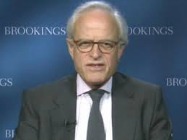 Martin Indyk
On July 29, 2013, Secretary of State Kerry named Indyk to be the U.S. special envoy for the Israeli-Palestinian
negotiations. Indyk previously served in a number of high-level U.S. government positions, including Ambassador to
Israel and Assistant Secretary of State for Near Eastern Affairs. As envoy, he is on leave of absence from his
current position as the vice president and director of the Foreign Policy Program at the Brooking Institution.
 News Nosh Special Section
During this exciting time, News Nosh, our free, daily news roundup, will cover the latest news and analysis. Click
HERE to get the News Nosh email delivered to you.
 APN's "Facts on Ground" map app. Includes pins and embedded
information/links covering settlement developments in the news.
APN's "Facts on Ground" map app. Includes pins and embedded
information/links covering settlement developments in the news.