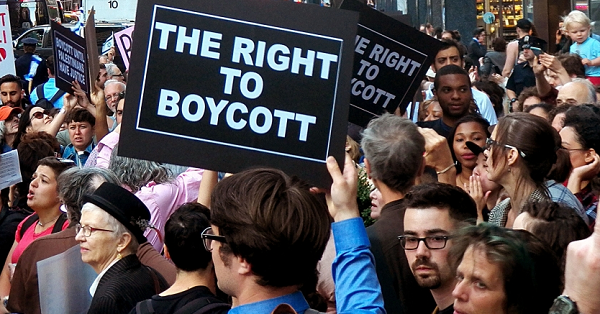
(UPDATE: As of January 15, Senate Majority Leader McConnell has tried to advance S.1, the bill that includes the so-called "Combating BDS Act," three times. Each time, McConnell's motions have failed to clear the 60-vote hurdle to advance, thanks to the vast majority of the Democratic caucus voting against cloture. And each time, immediately after his cloture motions have failed, McConnell has filed for a subsequent vote, in the apparent belief that putting Democratic senators on record voting against advancing S.1 will enable Republicans to paint the Democratic party as insufficiently "pro-Israel."
The vote tallies are as follows. On January 8, S.1 failed to advance by a vote of 56-44. On January 10, the tally was 53-43. And on January 14, the vote was 50-43. During the first two votes, four Democrats joined with Republicans in voting to advance S.1: Senators Manchin, Menendez, Sinema, and Jones. In the third vote, Senator Menendez, dropped his support because “I don’t like the Majority Leader using the US-Israel relationship as a political pawn.” McConnell has entered a motion for a fourth vote to advance S.1, but as of this writing that vote has not yet been scheduled.)
Americans for Peace Now (APN) opposes any bill that encourages state and local governments to adopt legislation which penalizes citizens who boycott Israel and/or Israeli settlements.
The Senate’s first piece of legislation in the 116th session, dubbed S.1, does just that. Referred to as the “Middle East Security Bill” by its sponsor, Senator Marco Rubio, S.1 incorporates the Combating BDS Act of 2019 into a larger bill that would appropriate security funds for Israel and reauthorize defense cooperation between the US and Jordan.





 As part of a group of non-Israeli academics assembled by Tel Aviv University, I visited the
Temple Mount in July 2017. On the next day, two Israeli border police officers were shot there in a
terror attack. I had the opportunity to make a condolence visit to Hurfeish, the Druze village in the
Galilee from which the two policemen (who were cousins) hailed. In the intimate setting of the room in which
female relatives were mourning, I told an aunt of the slain men that I was coming to work for the American
sister organization of Shalom Achshav and wanted to help in any way I could.
As part of a group of non-Israeli academics assembled by Tel Aviv University, I visited the
Temple Mount in July 2017. On the next day, two Israeli border police officers were shot there in a
terror attack. I had the opportunity to make a condolence visit to Hurfeish, the Druze village in the
Galilee from which the two policemen (who were cousins) hailed. In the intimate setting of the room in which
female relatives were mourning, I told an aunt of the slain men that I was coming to work for the American
sister organization of Shalom Achshav and wanted to help in any way I could.
 She looked at me, grief-stricken and weary, and said, "Make peace."
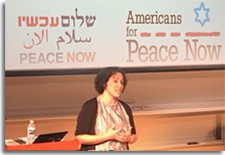 I left the Ivory Tower and came to work for APN in August 2017, when the prospects for
Israeli-Palestinian peace weren’t exactly heating up. Am I a little nuts? Possibly. But no more so than
the right-wing settlers who picked up their game when it looked like the Oslo process would defeat them.
It’s precisely when the odds are against us that we must redouble our commitment—and put our energy and
money where our ideals are, as our opponents do. We must do more than look for hope; we must generate it
ourselves.
I left the Ivory Tower and came to work for APN in August 2017, when the prospects for
Israeli-Palestinian peace weren’t exactly heating up. Am I a little nuts? Possibly. But no more so than
the right-wing settlers who picked up their game when it looked like the Oslo process would defeat them.
It’s precisely when the odds are against us that we must redouble our commitment—and put our energy and
money where our ideals are, as our opponents do. We must do more than look for hope; we must generate it
ourselves.
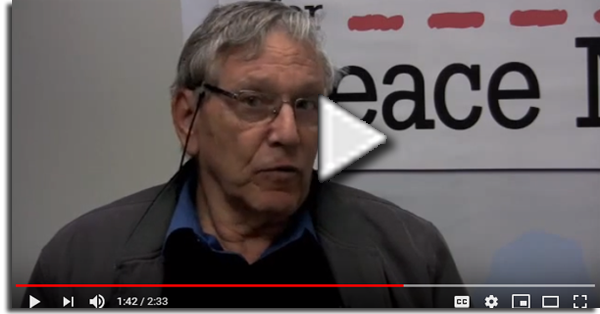
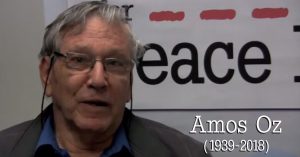 Americans for Peace Now (APN) sends its condolences to the Oz family and to the people of Israel,
who today lost Amos Oz, a literary giant, a beacon of morality and humanity, and a founder of Israel’s peace
movement.
Americans for Peace Now (APN) sends its condolences to the Oz family and to the people of Israel,
who today lost Amos Oz, a literary giant, a beacon of morality and humanity, and a founder of Israel’s peace
movement.